Short verdict
The Phrozen Sonic Mega 8K S is a genuinely large resin printer. Its 330 × 185 × 300 mm build volume gives a busy lab room to arrange sizeable batches of models rather than running one or two arches at a time. That capacity is the reason to buy it—and also the reason not to. A small lab that rarely fills the plate will be paying for a heavier machine, more resin in circulation, larger cleaning equipment, and more expensive failures without gaining much throughput.
As a 3D printer for dental lab model production, it makes the most sense for a team prepared to qualify its own process. Phrozen publishes clear hardware specifications, manuals, support articles, and firmware resources, and an independent hands-on review found the machine approachable despite its size. It is not, however, a turnkey clinical ecosystem simply because it can print fine detail.
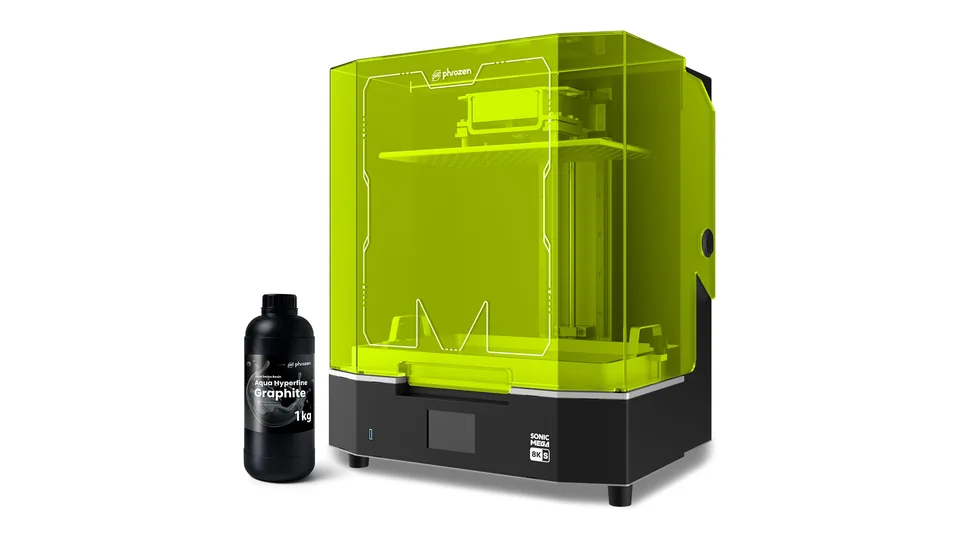
The supplied product image shows the Sonic Mega 8K S with a 1 kg bottle of Phrozen Aqua Hyperfine Graphite resin. Phrozen presents that resin for detailed models, prototypes, and display work—not as an intraoral dental material. Treat the pictured combination as a model-making bundle unless the seller and resin manufacturer provide documentation for a more specific use.
Check the Phrozen Sonic Mega 8K S on Amazon
What you are looking at
The printer is easy to identify from its proportions and front branding: this is Phrozen’s Sonic Mega 8K S, the simplified large-format sibling in the Mega range. The separate bottle in the image is Aqua Hyperfine Graphite. Phrozen’s own product page offers Aqua Hyperfine in 1 kg bottles and shows Graphite examples made on a Sonic Mega 8K S, so the pairing is plausible.
That still does not prove what the Amazon seller will ship. Marketplace photos can represent a bundle, a promotional pairing, or an older package. Before ordering, confirm whether resin is included, its color and expiry date, the printer’s plug and voltage, and whether the optional pump-and-fill hardware is part of the offer. The affiliate URL is preserved exactly as supplied, but price and package contents can change without notice.
Key specifications—and what they mean in a lab
Phrozen’s current help center lists the following specifications. These are useful planning numbers, not a substitute for measuring output from your own resin, orientation, wash, and cure process.
| Specification | Published figure | Practical meaning |
|---|---|---|
| Build volume | 330 × 185 × 300 mm | Enough area for large model batches or tall non-dental prototypes |
| XY resolution | 43 μm | Fine nominal pixel pitch; finished accuracy still depends on the complete workflow |
| Layer height | 0.01–0.30 mm | Broad setting range, though validated resin profiles should control production settings |
| Exposure system | 405 nm LCD with ParaLED Matrix | Compatible wavelength is only the first material check; a profile and intended use are still needed |
| Release film | ACF | Supports the machine’s large-format workflow but becomes a planned consumable |
| Slicer | CHITUBOX 1.9.6 or later | Familiar software, with production settings transferred by front USB |
| Published speed | Average 600 layers per hour | Manufacturer figure; part height, resin, lift settings, and geometry affect actual job time |
| Printer size | 472 × 380 × 566 mm | Requires a deep, stable work surface plus space to open the lift-up cover |
| Weight | 26 kg | A two-person placement plan is sensible; this is not a machine to move routinely |
| Maximum power | 240 W | Include the printer and post-processing equipment in the workstation’s electrical plan |
The most attractive number is not “8K”; it is the 330 × 185 mm platform. Resolution labels are poor shortcuts because the same pixel count spread over different screen sizes produces different pixel pitches. Phrozen publishes 43 μm, but a dental lab should care about repeatable dimensions after printing and post-curing, not the name printed on the cover.
When the large platform earns its keep
The Mega 8K S can turn a tall stack of queued model jobs into fewer print cycles. Because an LCD exposes a whole layer at once, adding more objects across the same layer does not increase exposure time in the way tracing each object would. For a production lab with predictable model demand, that can make scheduling easier: nest a batch, print overnight, and move the whole group into post-processing together.
Capacity is not automatically productivity. A nearly empty Mega platform gives little advantage over a smaller printer. A crowded platform also increases the value at risk when a profile, support, file, or release-film problem spoils the run. The lab needs a nesting rule, minimum separation, support standards, resin-temperature range, and a method for confirming that parts at the center and corners remain within tolerance.
Run the qualification across the plate rather than measuring one convenient model. Print the same reference object in several positions, record dimensions before and after post-cure, and repeat the job on different days and resin lots. That exercise tells you whether the machine’s size is usable production area or merely impressive capacity on paper.
The included-looking resin is the crucial limitation
Aqua Hyperfine Graphite is a general high-detail photopolymer. Phrozen markets it for character models, prototyping, and display objects. The company’s resin-selection guide lists dental resins separately, including materials intended for study models and orthodontic models. That separation matters.
Use Aqua Hyperfine for non-patient-contact models and process trials only after dialing in a profile and checking dimensional results. Do not infer that it is suitable for surgical guides, splints, custom trays, denture bases, temporary restorations, indirect bonding trays, or any other device that enters the mouth. A sharp print and 405 nm compatibility do not establish biocompatibility or a dental indication.
For patient-contact production, start with the exact material’s current instructions for use. Those instructions should support the printer or a documented equivalent and specify orientation, layer settings, washing, drying, cure equipment, cure cycle, finishing, and intended use. The FDA’s overview of additively manufactured medical devices explains why the process is part of the device: post-processing and validation can determine final characteristics that are not obvious from visual inspection.
Our dental resin compatibility guide explains how to verify that evidence chain before approving a material.
Setup is simpler than the footprint suggests
Tom’s Hardware reported that its review unit arrived with the build platform factory-leveled and a screen protector already installed. The reviewer also found the touchscreen navigation straightforward. Those are welcome details on a 26 kg printer, but “factory-leveled” should not become “never verify.” Inspect the machine after shipping, check the vat and release film, follow the current setup guide, and confirm the first layers with a controlled calibration print.
The lift-up cover is more convenient than a loose acrylic hood, yet it changes where the machine can live. Allow clearance behind and above it, leave access to the front USB port, and provide a stable surface that will not flex under the printer and a resin-filled vat. The work zone also needs room for draining a large build plate without carrying uncured resin across the lab.
Phrozen documents an optional pump-and-fill accessory for the Mega 8K S family. It may reduce the awkwardness of moving resin in and out of a large vat, but do not assume it is included. Confirm compatibility with the exact production revision and decide how the lab will prevent cross-contamination when changing materials.
Post-processing must match the batch size
Buying a large printer and pairing it with a small wash container creates a bottleneck. Plan how the largest routine batch will be removed, drained, washed, dried, inspected, and cured without mixing jobs or losing traceability. You may choose to process models in smaller groups, but then labor—not printing—can become the limiting step.
Liquid photopolymer also deserves a formal safety plan. CDC/NIOSH guidance notes that uncured resins may contain acrylates and other chemicals associated with skin and respiratory sensitization. Printing, washing, curing, and sanding introduce different exposure routes. Use the resin safety data sheet to choose compatible gloves and eye protection, control spills and ventilation, keep wash containers closed, and manage contaminated wipes, supports, solvent, and failed parts under local rules.
Our resin-printing workstation guide covers the dirty-to-clean flow. On a Mega-sized system, that physical flow is not a minor detail; it determines whether staff can handle batches without dripping resin through unrelated work areas.
Ownership cost beyond the Amazon price
The listing price is only the entry ticket. A realistic budget should include:
- a wash and cure arrangement sized for the lab’s routine batches;
- resin held in the vat and bottles, plus calibration and failed-print allowance;
- replacement ACF film, vats, screen protection, and eventually an LCD;
- suitable gloves, eye protection, ventilation, spill supplies, and waste handling;
- a stable bench, electrical capacity, and space around the open cover;
- measurement tools and staff time for process qualification;
- downtime, shipping, and return freight if service is not local.
Phrozen’s published warranty table is also worth reading rather than assuming every component has the same coverage. The current help center lists three months for the monochrome LCD, twelve months for several major printer components, and no warranty for release film. Regional seller terms may differ, so obtain them in writing.
Use the dental 3D printer price guide to compare complete cells rather than bare machines.
How it compares with dental-focused alternatives
The Mega 8K S wins on raw platform area. It is a credible choice when large batches of measured models are the priority and the lab has enough technical capacity to qualify materials and maintain the workflow. It is less convincing when the main goal is a short path to documented patient-contact applications.
The Phrozen Sonic XL 4K 2022 review covers a smaller Phrozen platform with published dental resin profiles. The Formlabs Form 4B review examines a more integrated dental ecosystem, while the CARIMA IML review considers a compact dental-positioned machine. Smaller platforms may produce more separate jobs, but their documentation and material workflows can reduce the validation burden.
If you have not settled on the equipment category, start with the dental 3D printer guide and our guide to choosing a 3D printer for a dental lab.
Questions to ask before ordering
- Is the seller shipping a new Sonic Mega 8K S, and what is the production revision?
- Does the package include Aqua Hyperfine Graphite resin, the pump-and-fill unit, or neither?
- What voltage and plug will ship, and who handles warranty service in your region?
- What are the return window and return-freight terms after a resin test?
- Are replacement ACF film, vats, LCDs, and screen protectors currently stocked?
- Which resin profiles are available for the exact applications you intend to run?
- Which wash and cure equipment can accept your planned batch size?
- For any patient-contact application, does the material manufacturer document the complete printer and post-cure workflow?
If the answer to a workflow question is only “it is a 405 nm printer,” treat the workflow as unverified.
Final buying recommendation
The Sonic Mega 8K S is easy to recommend for one specific buyer: a lab with enough recurring non-intraoral model volume to fill a large platform and enough process discipline to validate it. The hardware is documented, the build area is unusually useful, and independent hands-on reporting supports the claim that it is manageable despite its scale.
It is not the default choice for every dental lab. Low volume wastes its principal advantage, large-batch failures are costly, and the pictured Aqua Hyperfine resin does not turn the package into a clinical dental system. Buy it for capacity, not for the “8K” badge, and only after the lab has budgeted for equally capable washing, curing, measurement, safety, and support.