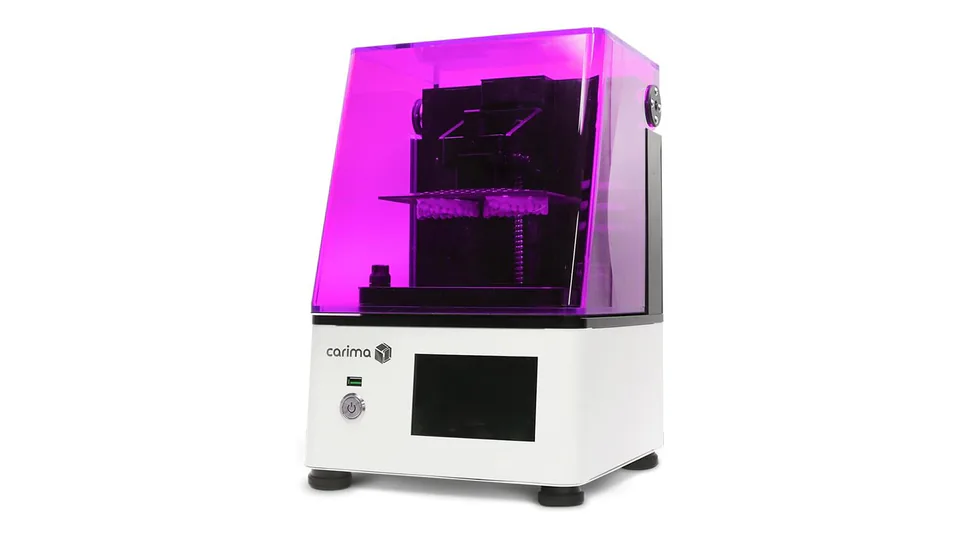
Short verdict
CARIMA IML is an interesting compact LCD printer for dental labs and practices that want a 405 nm system, a choice of two build-platform sizes, and an open-material proposition. CARIMA positions it for dental prosthetics and highlights a 35 micrometre pixel size, selectable layer thicknesses, heating, polarization correction, and compatibility with third-party dental resins.
Its strength is a focused specification set in a relatively small machine. Its risk is the gap between being technically open and having a fully supported, indication-specific production workflow in the buyer’s region. Before purchase, confirm the Amazon seller, unit condition, warranty, software license, local support, replacement parts, and the exact resin-to-wash-to-cure process for every appliance you intend to make.
Core specifications
CARIMA’s current IML page and leaflet identify an LCD vat-photopolymerization printer with a 405 nm UV LED, 4K 4098 × 2560 resolution, and 35 micrometre XY pixel size. The listed layer options are 25, 50, 75, 100, 125, and 150 micrometres. These values describe the imaging and slicing setup; they do not by themselves prove dimensional accuracy for a finished appliance.
Two magnetically attached build platforms are documented:
- a normal platform with a 142 × 88 × 100 mm build volume;
- a small platform with a 38 × 28 × 100 mm build volume.
The larger platform is the more relevant reference for batches of models or guides. The small platform may reduce resin handling for a compact job, but the buyer should ask whether both platforms are included in the exact package and whether separate vats or material-change procedures are needed.
The leaflet lists a machine size of 250 × 266 × 391 mm and a weight of 13 kg, with a DC 24 V, 10 A adapter. Aniwaa independently reproduces the 142 × 88 × 100 mm build envelope, 405 nm light source, 4K LCD, 13 kg weight, and compact dimensions, and labels the price as quote-led. Because Aniwaa states that its database is no longer actively maintained, current CARIMA documentation takes priority where details conflict.
Speed, precision, and light-uniformity claims
CARIMA says the IML can produce crown-and-bridge work in eight minutes, describes it as more than three times faster than other LCD printers, claims precision below 40 micrometres, and reports 98% overall light uniformity from its polarization-correction system. These are manufacturer claims under unspecified or product-specific test conditions, not Dental Spec Guide measurements.
A meaningful demonstration should disclose the resin, geometry, layer height, orientation, support strategy, build occupancy, software profile, ambient temperature, and definition of a successful part. Ask CARIMA or the seller to print one of your routine files, then inspect the complete workflow rather than the exposure time alone. Measure preparation, printing, draining, washing, drying, curing, support removal, finishing, inspection, and remake rate.
Uniform light is potentially relevant to consistency across the platform, but a percentage on a product page is not a substitute for part measurement. If accuracy matters to fit, request a repeatability study across multiple platform positions and several print cycles using your intended resin and post-processing process.
Heating and material workflow
The IML includes a heating mechanism that CARIMA says can reach a maximum of 35°C depending on the resin. Heating can help keep resin conditions consistent, but it is not a universal setting. Confirm whether the system heats the chamber or resin, how temperature is measured, how long stabilization takes, and which profiles require heat.
CARIMA describes IML as an open-material system compatible with third-party dental resins. The leaflet names several material partners, but compatibility must be treated as resin- and indication-specific. For a dental appliance, obtain documentation covering:
- the exact resin and market authorization for the intended indication;
- IML exposure profile and supported layer height;
- build-platform preparation and environmental limits;
- approved wash liquid, equipment, duration, and drying step;
- post-cure wavelength, temperature, orientation, and time;
- traceability, cleaning, finishing, and quality-control requirements.
An open system transfers more validation responsibility to the buyer. If the resin maker and printer maker publish different instructions, resolve the conflict in writing before production.
Slicer and file preparation
CARIMA lists CARIMA Slicer V2 and Chitubox Pro for CARIMA, with the leaflet indicating a software choice. Confirm which license is included, whether it is perpetual or subscription-based, supported operating systems, update policy, import formats, network requirements, and access to validated profiles.
The best software test is operational. Import a representative dental file, orient it, generate supports, nest multiple parts, apply the intended resin profile, export the job, and document how settings are locked or audited. Ask whether the printer can continue working if a cloud or licensing service is unavailable, and whether patient-identifiable information ever leaves the local workstation.
Price, seller, warranty, and support
CARIMA does not show a dependable global public price on the sources reviewed. The Amazon link provides a US purchase route, but this page does not reproduce Amazon pricing, availability, seller claims, or customer feedback. Verify those details directly before ordering.
For a high-value professional device, seller identity matters. Ask whether the seller is authorized by CARIMA, whether the unit is new and intended for the US market, and who provides installation, training, warranty work, and replacement parts. Obtain the serial-number policy and warranty document before payment. A marketplace return window is not equivalent to a manufacturer service program.
Budget for the complete workflow: printer, both intended platforms, vats, resin, software, wash equipment, curing equipment, ventilation, personal protective equipment, solvent handling, maintenance parts, calibration tools, training, and failed-job allowance.
Evidence-backed positives and limitations
Reasons to shortlist
- Compact 13 kg footprint with two documented platform sizes.
- Current official specification confirms 405 nm light, 35 micrometre pixel size, and multiple layer-height choices.
- Heating and polarization correction address two practical process-control areas.
- Open-material positioning gives buyers a path to third-party dental resins.
- Official specifications are corroborated in a manufacturer-validated independent database entry.
Reasons to remain cautious
- Speed, precision, and light-uniformity figures are manufacturer claims that require workflow-specific verification.
- Open material support does not prove a validated dental indication.
- Public pricing is not stable enough to reproduce here.
- Amazon seller authorization, warranty, training, and local service need written confirmation.
- Independent long-term dental workflow evidence is limited.
Alternatives
Compare Formlabs Form 4B if you value a more guided dental ecosystem, automatic resin handling, broad documentation, and structured service. Compare Phrozen Sonic XL 4K 2022 if a larger build volume and published dental resin profiles matter, while checking unit condition and replacement support. Compare Asiga MAX 2 when DLP technology, compact dimensions, and established open-material architecture are the main priorities.
Final buying recommendation
CARIMA IML belongs on a shortlist when space, 405 nm material options, and open-material flexibility are important. Approve it only after a representative print trial, a complete workflow-cost estimate, and written confirmation of seller authorization, warranty, software, service, parts, and indication-specific resin procedures.