Short verdict
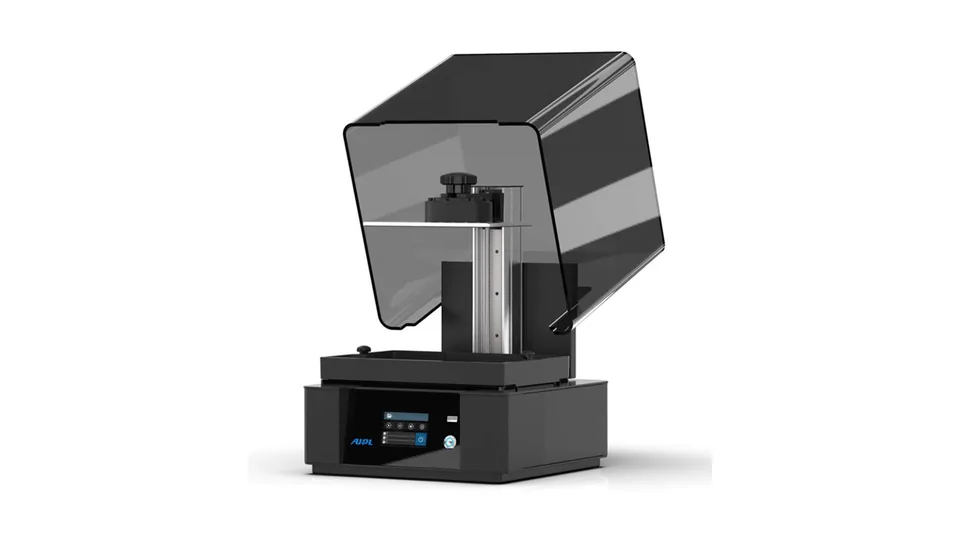
The AUPL printer in the supplied image appears to be the AUPL APL192, an older 8.9-inch LCD resin printer marketed through distributors for jewelry and dental work. That identification is probable, not proven. We found a reseller record naming the APL192 and a supplier directory connecting AUPL machines with 405 nm resin printing, but no current official product page, manual, resin library, or dental indications for the exact Amazon unit.
That makes this a conditional recommendation. A price-sensitive dental lab could consider the machine for measured study models, prototypes, or sacrificial casting patterns if the seller first confirms the model and the lab validates the complete process. It should not be treated as a ready-to-run clinical production system. A dark cover, fine-looking sample print, or the word “dental” in marketplace copy does not establish a workflow for surgical guides, splints, custom trays, dentures, or temporary restorations.
The printer may be inexpensive beside a supported dental system, but incomplete documentation transfers work and risk to the buyer. If you cannot obtain a manual, wavelength, build dimensions, replacement-part route, resin profiles, and support terms before purchase, the sensible answer is to pass.
Check the AUPL resin 3D printer on Amazon
What is this AUPL printer?
Public records around this machine are fragmented. AYARD, a Japanese 3D-printer retailer, lists an AUPL APL192 as an 8.9-inch, 2K LCD printer for jewelry and dental settings. An Alibaba supplier directory attributes AUPL LCD printers to Shenzhen Beautystar Technology and mentions 405 nm curing, dental and jewelry positioning, and a larger AUPL format. The black machine in the publisher-supplied image carries the AUPL logo and is visually consistent with reseller imagery from this product family.
None of those clues proves that the Amazon listing is the APL192. Marketplace inventory can combine old photos, private-label variants, renewed stock, and packages from different production runs. The first buying step is therefore not comparing resolution; it is asking the seller for a photograph of the rating plate and a PDF manual that names the delivered model.
The reported “2K” description also needs context. It describes the LCD mask’s resolution class, not the dimensional accuracy of a finished dental model. Pixel pitch depends on both pixel count and exposed area, while fit also depends on optics, motion, resin behavior, temperature, supports, orientation, washing, curing, and calibration. Without a technical sheet and measured parts, a 2K label cannot answer whether the printer is accurate enough for your application.
| Item | What public records report | What the seller still needs to prove |
|---|---|---|
| Likely model | AUPL APL192 | Rating-plate photo and matching manual for the delivered unit |
| Process | Masked LCD vat photopolymerization | Exact screen type, replacement LCD availability, and firmware |
| Display class | 8.9-inch, 2K in the AYARD record | Native pixel count, exposed area, pixel pitch, and uniformity |
| Light source | 405 nm appears in the AUPL supplier record | Actual wavelength, irradiance control, and compatible resin profiles |
| Applications | Marketed for jewelry and dental settings | Specific intended uses, validated materials, and regional documentation |
| Build volume | Not confirmed for this exact unit | X, Y, and Z capacity from a model-specific datasheet |
| Software | Not documented in the sources we found | Supported slicer, file format, operating systems, updates, and offline use |
| Support | Not established | Warranty owner, return freight, parts stock, training, and response time |
Where it could fit in a dental lab
The most plausible role is as a low-cost secondary resin printer for work that never goes into a patient’s mouth. Think diagnostic or presentation models, process trials, non-clinical prototypes, and castable patterns where the lab controls the investment and burnout workflow. Even those uses need qualification: print a representative test object, measure critical landmarks, repeat it in several platform positions, and track the result after washing and curing.
The LCD format can be productive because each layer is exposed as an image rather than traced point by point. That does not mean every job is fast, nor does it remove the need to account for lift motion, layer settings, supports, resin temperature, and post-processing. Batch capacity is only useful when the whole platform produces repeatable results.
For castable patterns, the printer is only one part of the chain. The exact resin needs a supported exposure profile, and the lab must validate cleaning, drying, curing if required, investment compatibility, burnout, and casting. A clean-looking pattern can still leave ash, crack an investment, distort, or produce a rough casting if the material and process are mismatched.
For models, define acceptance criteria before the first production job. “Looks detailed” is not a quality check. Use known reference geometry, a calibrated measurement method, documented orientation and support rules, and a repeatability study. If a model will influence appliance fit or a regulated manufacturing record, bring it under the lab’s quality system.
Why “dental” is not a clinical indication
This is the central limitation of the AUPL proposition. We found sales language placing the product in dental environments, but no model-specific evidence chain for an intraoral device. A dependable patient-contact workflow normally ties together the exact printer, software version, resin, orientation, layer settings, wash process, dry time, cure unit, cure program, finishing steps, and intended use.
The FDA’s explanation of 3D-printed medical-device production is useful here: dental materials are cleared for specific intended uses, not unlimited ones, and the manufacturing process may need validation where final characteristics cannot be checked without destroying the part. In practical terms, a resin bottle labeled “biocompatible” does not make every printer and cure routine acceptable.
Do not approve the AUPL from the listing alone for surgical guides, splints, night guards, custom trays, denture bases, temporary crowns, indirect bonding trays, or any other patient-contact output. Ask for the resin manufacturer’s current instructions for use and a compatibility statement covering the exact printer and post-cure equipment. If that documentation does not exist, keep the workflow outside patient care.
Use the dental 3D printer resin compatibility guide to map the evidence you need before pairing any printer and material.
AUPL dental 3D printer price: the number is only the start
There is no reliable current dental 3D printer price we can publish for this AUPL unit. Amazon prices, sellers, condition, and package contents can change. The historical Japanese reseller record is helpful for identifying the model family, but it is not a current US quotation and should not anchor a buying decision.
The more useful calculation is the cost of a working cell. Budget for:
- the printer, tax, shipping, and possible return freight;
- a wash setup, compatible solvent, sealed containers, and solvent management;
- a cure unit that meets each selected resin’s instructions;
- resin vats or trays, FEP or other release films, replacement LCDs, and build-platform consumables;
- resin, failed prints, calibration coupons, and validation batches;
- ventilation, spill control, suitable gloves, eye protection, and waste handling;
- slicing software, a suitable workstation, staff training, and documented procedures;
- measurement equipment and time for incoming inspection and process qualification;
- downtime risk if model-specific parts or technical support are unavailable.
This is why a 3D dental printers price list should separate general LCD hardware from supported dental ecosystems. Two machines with similar purchase prices can have very different ownership costs when one includes validated profiles, responsive support, training, and stocked parts while the other leaves those tasks to the lab.
For a broader cost framework, compare complete workflows in the dental 3D printer price guide.
Resin handling and post-processing
Liquid photopolymer changes the daily risk profile compared with an FDM printer. CDC/NIOSH guidance notes that uncured resin may contain acrylates and other chemicals associated with asthma or dermatitis, while printing, washing, curing, and sanding can create additional exposure routes. A tinted cover is not a substitute for a workplace assessment or effective ventilation.
Plan the space before the printer arrives. Keep resin handling away from clean CAD and inspection areas; use compatible gloves and other PPE based on the resin and solvent safety data sheets; contain drips; keep wash containers closed; allow parts to dry fully before curing; and manage contaminated wipes, gloves, solvent, supports, and failed prints under local rules. The dental 3D printing workstation guide covers how these zones fit together.
Post-curing is not simply “more UV.” Wavelength, irradiance, temperature, exposure time, geometry, and light access can affect conversion and final properties. Follow the material’s current instructions rather than inventing a generic cure cycle. If the resin manufacturer does not support your printer-and-cure combination, that uncertainty belongs in the purchase decision.
AUPL versus a supported dental resin printer
The AUPL’s case is low entry cost and an apparently straightforward LCD architecture. Its weakness is the missing documentation around the exact unit. That can be acceptable for an experienced lab running low-risk experiments; it is a poor foundation for a team that needs turnkey production, indication-specific materials, traceability, and accountable support.
The CARIMA IML review covers a compact machine positioned specifically for dental work. The Phrozen Sonic XL 4K 2022 review examines a larger dental platform with published resin profiles, while the Formlabs Form 4B review looks at a more integrated dental ecosystem. None should be approved from marketing claims alone, but each starts with a clearer documentation trail than we found for the AUPL.
Labs still deciding which category fits their workload should begin with the dental 3D printer guide and the best 3D printer for a dental lab guide.
Questions to send the Amazon seller
Before ordering, ask for written answers to these points:
- What exact model and production revision will ship?
- Can the seller provide a rating-plate photo, current manual, and complete specification sheet?
- What are the native LCD resolution, exposed build area, build height, and nominal wavelength?
- Which slicer and firmware versions are supported today?
- Which resin manufacturers publish profiles for this exact model?
- Are a vat, build platform, spare release film, tools, and power supply included?
- Who owns the warranty, where are repairs performed, and who pays return freight?
- Are replacement LCDs, vats, release films, and Z-axis components in stock?
- Is the unit new, old stock, returned, refurbished, or relabeled?
- What dental intended uses, if any, are supported by model-specific documentation rather than listing copy?
If the reply substitutes sample photos or broad claims for documents, consider the specification unresolved.
Final buying recommendation
The likely AUPL APL192 is interesting as an inexpensive resin printer, not as a proven dental production system. A capable lab might turn it into a useful tool for measured models, prototypes, or sacrificial patterns, but doing so requires more verification and internal validation than the low hardware price suggests.
Buy only when the seller proves the exact model, supplies usable documentation, identifies supported software and parts, and offers a return policy that gives you time to inspect and test the machine. Keep patient-contact work off the table unless the exact printer, resin, settings, post-processing equipment, and intended use are supported together.
If your real need is a dependable 3D printer for a dental lab rather than a low-cost resin experiment, a current dental platform with documented material workflows and accountable service is likely the better long-term purchase.