Short verdict
The BIBO 2 Touch is an enclosed, dual-extruder FDM printer that can be useful in a dental lab—but it is not a purpose-built dental 3D printer. That distinction matters more than any headline specification. Its two nozzles, heated glass bed, removable enclosure panels, and support for common 1.75 mm filaments make it interesting for study models, prototype fixtures, equipment organizers, training pieces, and other non-intraoral work. They do not establish a validated workflow for surgical guides, splints, dentures, temporary restorations, or anything intended to contact a patient.
This is also an older platform. Independent reviewers liked its sturdy frame and print results for the price, but both described a workflow that feels dated beside current machines: manual bed leveling, a slow or awkward interface, and wireless file transfer that one owner found less convenient than using an SD card. Aniwaa now labels the model discontinued. Treat any current Amazon unit as a listing that needs careful verification, not as a current-generation dental production system with guaranteed parts and support.
For a lab that specifically needs inexpensive FDM capability and is prepared to qualify the complete process, BIBO may still earn a place on the longlist. If the actual goal is precise dental models, appliances, or a documented biocompatible workflow, start with a current dental resin printer instead.
Check the BIBO 3D printer on Amazon
What the BIBO 2 Touch actually is
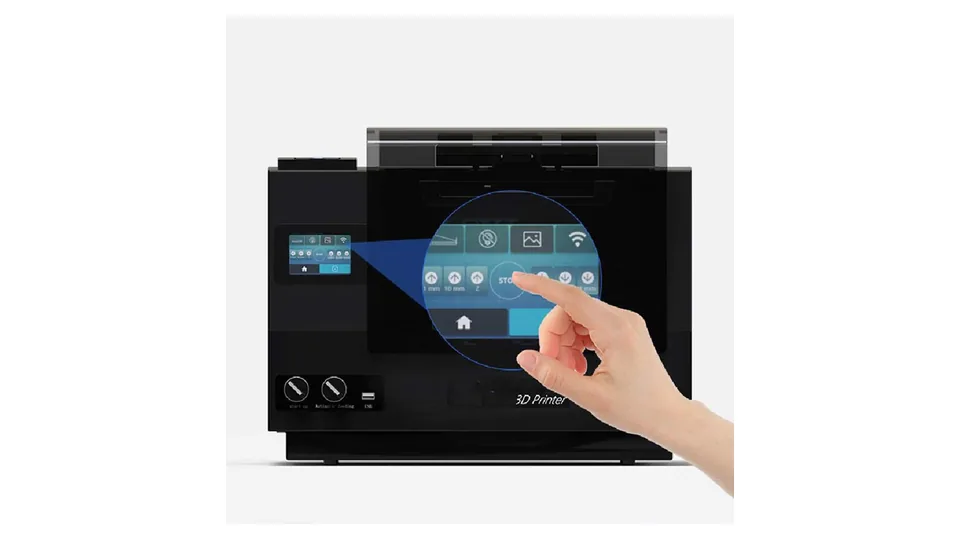
BIBO’s naming has never been especially clear. The machine is commonly called the BIBO 3D Printer, BIBO 2 Touch, or BIBO 2 Touch Laser, depending on whether the touchscreen and laser module are included. The product in the supplied image matches the enclosed BIBO dual-extruder format, but buyers should still confirm the exact variant in the cart. A laser engraver, Wi-Fi module, spare glass plate, or particular accessories should not be assumed from a family name or product photo.
At its core, this is a fused-deposition-modeling printer. It melts thermoplastic filament through two 0.4 mm nozzles mounted side by side on one carriage. It is not an independent-dual-extruder, or IDEX, machine. The second nozzle is useful for a soluble support material such as PVA or for two-color work, but inactive-nozzle oozing and added changeover time are part of this design.
The documented build area is 214 × 186 × 160 mm. Published specifications also list a 270°C maximum nozzle temperature, a heated glass bed reaching 100°C, 1.75 mm filament, and a 0.05–0.3 mm layer-height range. Those figures describe machine capability. They do not tell a dental lab what dimensional accuracy, surface detail, repeatability, or fit it will achieve after slicing, cooling, support removal, and handling.
| Item | Documented detail | What it means for a dental lab |
|---|---|---|
| Printing process | FDM/FFF material extrusion | Better suited to general thermoplastic parts than fine, validated dental-appliance production |
| Build volume | 214 × 186 × 160 mm | Enough for several small models or lab fixtures, subject to orientation and support needs |
| Extruders | Two direct-drive nozzles on one carriage | Enables two materials or colors; not true independent printing |
| Nozzle | 0.4 mm | Practical for general models, but visible layer lines and fine-detail limits should be expected |
| Layer range | 0.05–0.3 mm | A thin layer setting does not by itself prove clinical accuracy |
| Build surface | Removable heated glass bed, up to 100°C | Supports common thermoplastics but requires adhesion and leveling control |
| Connectivity | SD card, USB, and Wi-Fi in published documentation | Verify current software and network compatibility; local removable media may be simpler |
| Leveling | Manual | Adds operator time and another source of variation |
Where it may fit in a dental lab
The most defensible reason to buy this printer is to add low-cost FDM capability alongside—not instead of—a validated dental resin workflow. A dental lab often needs more than patient-specific appliances. Teams make drawer organizers, tool holders, scanner stands, alignment aids, packaging prototypes, demonstration pieces, training models, and one-off fixtures. For those jobs, filament is easy to store, the process avoids liquid-resin washing, and the enclosed frame can help with temperature-sensitive materials.
It may also be possible to produce study or thermoforming models, but “possible” is not the same as qualified. The lab should print a representative test set across the platform, measure known landmarks, repeat the job over several days, and check the result after cooling and any downstream heating. If the model affects appliance fit, occlusion, treatment planning, or a regulated manufacturing record, the lab’s quality process—not a marketplace description—has to decide whether the workflow is acceptable.
Dual extrusion can be genuinely useful for complex non-clinical geometry. A soluble support material may open internal channels or undercuts that would be tedious to clean mechanically. In practice, two materials introduce more variables: nozzle alignment, purge strategy, retraction, temperature changes, moisture control, and the risk of the idle nozzle marking the part. All3DP’s hands-on review found that cooling the inactive nozzle helped control oozing but extended print time. That is a credible reminder that “two extruders” is a workflow choice, not free speed.
Why this is not a dental appliance printer
Search results for “dental 3D printer” often mix general-purpose machines with printers sold as complete dental systems. The BIBO does not come with the evidence chain a lab should expect for a patient-contact device: an indication-specific material, a validated printer profile, documented post-processing, regional regulatory status, traceability, and a manufacturer-supported quality workflow.
FDM also behaves differently from vat-photopolymerization systems commonly used in digital dentistry. A 0.4 mm nozzle places beads of molten plastic, creating directional layer lines and corners that depend on extrusion, temperature, cooling, and motion. A dental resin printer exposes each layer as a controlled image and is usually paired with indication-specific wash and cure instructions. Neither process is automatically accurate, but the material and validation ecosystem around current dental resin systems is much closer to what appliance production requires.
Do not use the BIBO listing alone to justify direct-print splints, surgical guides, temporary restorations, dentures, custom trays, indirect bonding trays, or other intraoral items. A filament advertised as “biocompatible” is not enough. The exact combination of material, printer, settings, handling, cleaning, and intended use must be supported for the market in which the lab operates.
For a clearer view of those dependencies, use the dental 3D printer resin compatibility guide before comparing hardware.
BIBO dental 3D printer price: what to budget
There is no dependable BIBO dental 3D printer price to publish here. Amazon pricing, seller, stock, and package contents can change, and a third-party product directory currently describes the platform as discontinued. Check the live listing for the transaction price, but build the decision around total cost rather than the number beside the buy button.
Your working budget should include:
- the exact printer variant and any shipping, tax, or import cost;
- replacement nozzles, build plates, thermistors, heater parts, fans, belts, and other aging components;
- dry storage for hygroscopic support filament such as PVA;
- slicing and file-transfer software that still works with your current computers;
- ventilation appropriate to the selected filament and local workplace requirements;
- calibration tools, test prints, failed jobs, and staff time;
- measurement and documentation needed to qualify each lab use;
- the possibility that warranty service or model-specific parts are limited.
That is why a 3D dental printers price list can be misleading. A lower hardware price does not make an older general-purpose FDM unit equivalent to a current dental printer. Conversely, it may be economical for fixtures and prototypes if it keeps those low-risk jobs off a more expensive resin production cell. Compare complete workflows in the dental 3D printer price guide, not just purchase prices.
Day-to-day workflow and ownership risks
The printer arrives mostly assembled according to the owner review we examined, but it is not a plug-and-forget appliance. The bed is leveled manually, and the two nozzles must be aligned closely enough that the inactive nozzle does not drag through a print. Filament loading, first-layer adhesion, material moisture, slicer profiles, and enclosure use all affect the result.
The enclosure is useful, but it should not be mistaken for a documented actively heated chamber or a complete fume-control system. Material safety information and workplace controls still govern ventilation. When printing PLA, opening panels may improve cooling; when printing materials prone to warping, a stable enclosed environment may help. The right choice depends on the exact filament and the part.
Software longevity is another concern. The manufacturer manual covers Repetier-Host and printer-specific setup, while published reviews also mention Cura and Simplify3D. Confirm that a maintained slicer can produce compatible G-code, that the delivered firmware matches available documentation, and that you can recover the machine without relying on an abandoned cloud or utility. One Hackster reviewer found the Wi-Fi transfer setup cumbersome and preferred an SD card. For a lab, a simple local workflow may also be easier to document and keep off a patient-data network.
Before paying, ask the seller for the serial number, exact model name, manufacturing date, firmware version, included accessories, warranty terms, return freight policy, and source of replacement parts. If the seller cannot answer those questions, price the machine as unsupported equipment.
BIBO versus a dental resin printer
Choose the BIBO direction when the job is primarily a general thermoplastic part, larger feature size is acceptable, soluble supports are valuable, and your lab can validate the result internally. Choose a current dental resin system when fine surface detail, compact dental batches, indication-specific materials, traceability, and a documented post-processing chain are central to the job.
For a compact dental-oriented LCD alternative, read the CARIMA IML review. For a larger dental resin platform with published resin profiles, see the Phrozen Sonic XL 4K 2022 review. Neither should be approved from specifications alone, but both begin closer to a dental production workflow than this BIBO FDM machine.
Labs comparing several categories should also use the best dental 3D printer for a dental lab guide and plan the surrounding controls in the dental 3D printing workstation guide.
Final buying recommendation
The BIBO 2 Touch can still make sense as a secondary, general-purpose printer in a dental lab. Its enclosed metal frame, heated glass bed, and two-nozzle setup give it more flexibility than a basic open-frame FDM machine. The tradeoff is an aging workflow, uncertain current support, manual setup, and no established dental-appliance validation.
Buy it only if you have a defined non-intraoral job list, can confirm the exact Amazon variant and seller support, and are prepared to qualify dimensional performance for every use that matters. If you are really shopping for a dental 3D printer to produce guides, splints, restorations, or other patient-contact items, compare the supported systems in the dental 3D printer guide instead.